
Eco-Friendly Commercial Flooring Choices for Minneapolis & St. Paul Businesses
Published September 22, 2026
Sustainability in commercial flooring is usually treated as a materials question: which product is greenest. For a facility manager or design team working on a building in Minneapolis or St. Paul, that framing skips the bigger question. Before any material gets selected, the existing floor deserves a look, because keeping a structurally sound floor in service is often the lowest-impact decision available.
The Most Sustainable Floor Is Often the One Already There
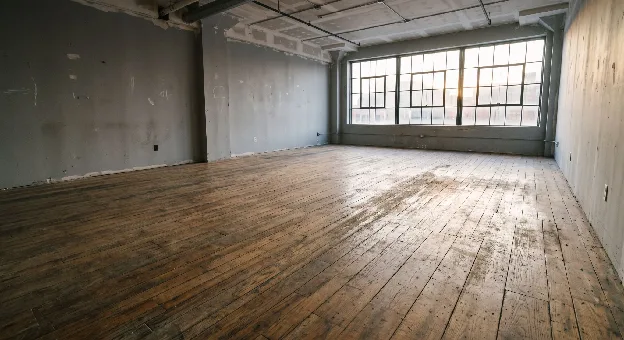
Refinishing a wood floor and completely replacing it aren't even in the same ballpark environmentally. Refinishing just takes a bit of sandpaper and a fresh topcoat. Replacement, on the other hand, triggers a massive chain reaction: demolition, landfill waste, manufacturing new planks, long-distance freight, and fresh adhesives. When calculating a project's true eco-impact, the biggest factor isn't what you use to refresh the floor; it's the huge pile of new resources you completely avoid using.
This is why the sustainability conversation should start with an assessment of the existing floor rather than a comparison of new products. Above The Rest Floors & More offers commercial wood flooring installation alongside adhesive removal, moisture mitigation, concrete repair, cementitious underlayment, and gypsum underlayment, which means a floor's substrate and surface condition can both be evaluated as part of the same project rather than treated as separate concerns.
Above The Rest Floors & More doesn't market a sustainability program. What the company does is assess whether an existing floor can be refinished before quoting a replacement, because keeping a floor in service is the largest environmental decision in any flooring project.
Why Wear Layer Thickness Is a Sustainability Decision
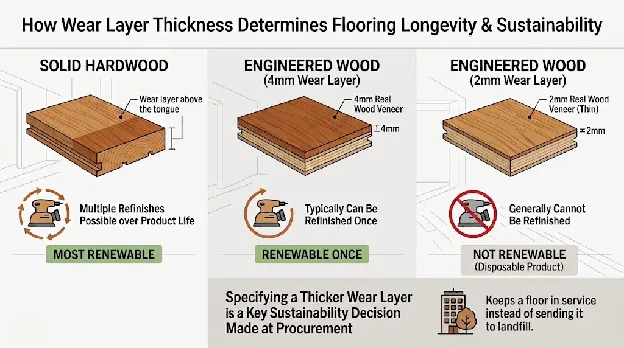
Whether a floor can ever be refinished is decided long before the first sign of wear, at the point the product is specified. Solid hardwood can typically be refinished several times over its life. Engineered wood depends entirely on the thickness of its real-wood wear layer: a 4mm veneer can usually be refinished once, while a 2mm veneer generally cannot be refinished at all.
| Flooring Type | Typical Refinishing Capacity |
|---|---|
| Solid hardwood | Multiple refinishes over its service life |
| Engineered wood, 4mm wear layer | Commonly refinished once |
| Engineered wood, 2mm wear layer | Generally can't be refinished |
A thin wear layer is, in practical terms, a disposable product with a wood surface. Specifying a thicker wear layer is a sustainability decision made at procurement, years before it has any visible effect on the floor.
What Actually Counts as Eco-Friendly in Commercial Flooring
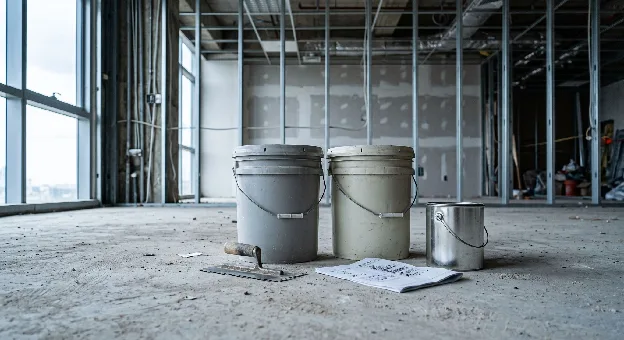
A single material label doesn't describe the full impact of a flooring decision. A more complete review looks at several factors together:
- Service life: how long the floor can be used before it needs replacing, which is usually the dominant factor and the one most often ignored
- Indoor air quality: the adhesives and finishes used during installation, since occupants breathe the air in the space during and after the work
- Material sourcing: where and how a product is made, which matters, but durability matters more
- End-of-life handling: what happens to the old floor once it comes out
- Substrate reuse: whether an existing slab can be prepared and reused instead of covered with new material
Above The Rest Floors & More assesses concrete moisture with ASTM F2170 in-situ relative-humidity testing on every project and follows National Wood Flooring Association installation guidance for substrate flatness, acclimation, fastening, and finishing. Moisture verification against these standards helps prevent avoidable flooring failure that leads to an early, unnecessary replacement.
Polished Concrete: The Slab You Already Own
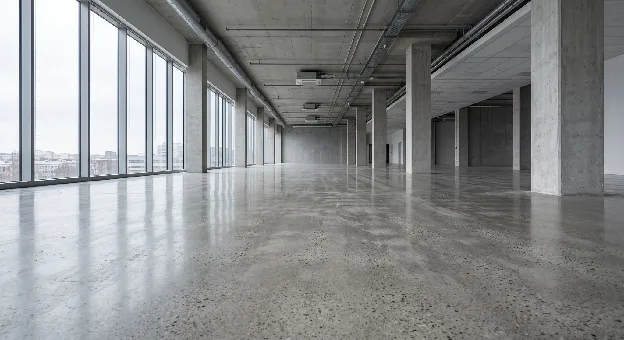
If a building already has a structural concrete slab, polished concrete uses that slab as the finished floor surface. There's no new flooring material to manufacture or ship, no adhesive layer, and no old floor covering to dispose of. Plus, a polished slab can remain in service for decades. It's one of the more direct examples of the lifecycle principle at work: the material with the smallest environmental footprint is often the one already in the building.
If an old floor covering has adhesive residue on the slab, that residue has to come off before the concrete can be polished, leveled, or prepared for a new finish. ATR's Clean Slate process chemically removes old adhesive rather than grinding over it, which preserves more of the usable substrate underneath for whatever comes next, whether that's polishing, moisture mitigation, or a new floor finish.
Durability Is Sustainability in a Minnesota Building
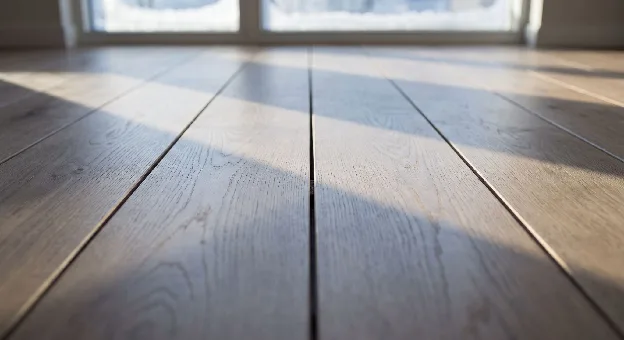
Minnesota's seasonal humidity swing is a sustainability issue as much as a performance one. Twin Cities buildings can see very low indoor relative humidity during winter heating season and humidity above 60% during summer without dehumidification. That swing contributes to winter gapping and summer cupping in wood floors. A floor that cups every July and gaps every January is a floor that gets replaced early, and an early replacement is the largest avoidable environmental cost in the entire lifecycle of that floor.
This is especially relevant on office and tenant improvement projects in Minneapolis and St. Paul, where sustainability requirements are increasingly written directly into the project specification. Specifying for the Twin Cities climate, engineered construction with an adequate wear layer over solid where movement is a concern, a moisture-verified substrate, and stable building HVAC, keeps a floor in service for its full intended life instead of failing years early.
On a recent tenant-improvement project in an occupied Twin Cities office building, an existing engineered wood floor had been slated for full demolition and replacement as part of the renovation scope. A site assessment found the floor structurally sound with enough wear layer remaining to refinish. Refinishing kept the floor in place, and the project avoided the demolition, disposal, and new material that a full replacement would have required.
Questions to Ask a Flooring Contractor About Sustainability
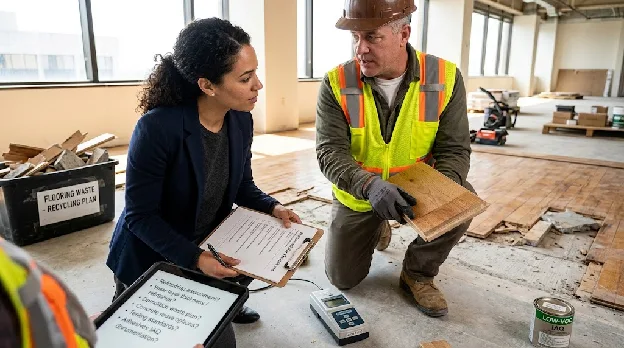
A facility manager or designer evaluating flooring on a sustainability basis can get a clear answer from a contractor by asking:
- Was the existing floor assessed for refinishing before a replacement was recommended?
- What is the wear layer thickness on any engineered wood product being quoted, and how many times can it be refinished?
- What happens to the demolition waste from the old floor?
- Can an existing concrete slab be reused instead of covered with a new floor covering?
- What testing is performed on the concrete slab before installation, and against what standard?
- What adhesives and finishes are being used, and can their indoor air quality documentation be provided?
Frequently Asked Questions
Is refinishing a commercial floor better for the environment than replacing it?
Refinishing a commercial floor is generally better for the environment than replacing it. Refinishing consumes sanding abrasives and finish while replacement adds demolition, disposal, new material manufacturing, freight, and adhesive to the project.
How do I know whether an existing commercial wood floor can be refinished instead of replaced?
Whether an existing commercial wood floor can be refinished instead of replaced depends on whether the floor is structurally sound, has sufficient wear layer remaining, and has no underlying subfloor damage, which is determined by a site assessment.
What should a facility manager ask about adhesives and finishes when evaluating eco-friendly commercial flooring?
A facility manager evaluating eco-friendly commercial flooring should ask what adhesives and finishes are being used and whether documentation on their indoor air quality impact is available, since occupants are exposed to these products during and after installation.
Ready to Talk Through Your Flooring Options?
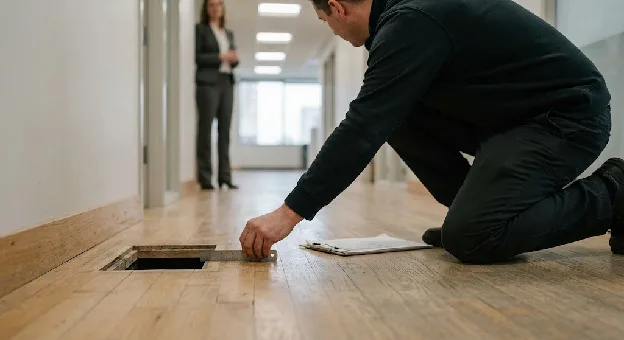
Above The Rest Floors & More has been installing and restoring commercial flooring across the Twin Cities metro since 1998 and is 100% woman-owned, a qualification that can matter for buyers with supplier-diversity requirements. Before quoting a replacement, we assess whether your existing floor can be refinished. Our installations carry a 2-year written workmanship warranty.
Call (651) 463-1250 to schedule a site walk for your Minneapolis, St. Paul, Fridley, Roseville, or Anoka property.

About the author
Nick Winscher
Sales Manager / Senior Project Manager
Nick brings more than 20 years of commercial construction and flooring experience to project planning, underlayments, floor leveling, and delivery.