
Hardwood remains one of the most requested finished floors for commercial interiors, and for good reason. It gives lobbies, offices, and dining rooms a warm, upscale look while standing up to daily business use when it is specified correctly. The right choice depends on foot traffic, the subfloor underneath it, moisture conditions in the building, and how much wear layer the product has to give over its lifespan. Above The Rest Floors & More installs commercial wood flooring across the Twin Cities metro, along with the concrete repair, moisture mitigation, adhesive removal, and underlayment work that a successful installation depends on.
Why Businesses Choose Hardwood
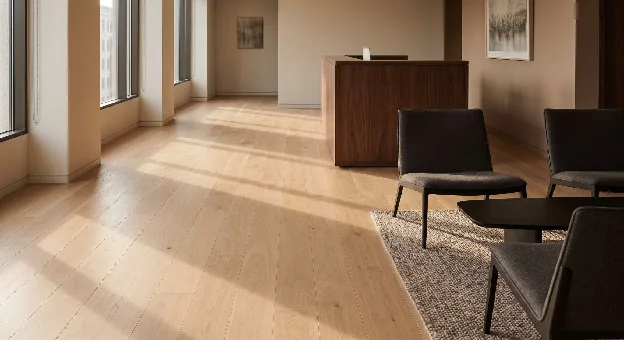
Hardwood gives commercial spaces a level of warmth and permanence that few other finished floors can match. It reads as an investment to clients and guests, which is why it shows up so often in office lobbies, boardrooms, reception areas, hotel lobbies, restaurant dining rooms, and boutique retail across Minneapolis, St. Paul, and the surrounding suburbs. Unlike some finished flooring products, hardwood can also be refinished rather than replaced when it starts to show wear, which extends its useful life and can protect the original investment.
Solid vs. Engineered Hardwood: Choosing the Right Construction
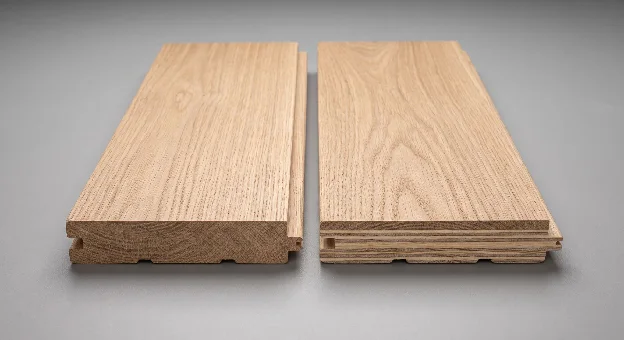
The biggest decision in a commercial hardwood project is not the species or stain color, it is the underlying construction. Solid hardwood and engineered hardwood look similar once finished, but they perform very differently depending on the building.
- Solid hardwood is typically a 3/4-inch product that needs a plywood subfloor and stable moisture conditions to perform well over time.
- Engineered hardwood has a real-wood wear layer over a more dimensionally stable core, which allows it to be installed over concrete and to better handle building environments where moisture conditions shift.
Neither construction is automatically the better choice. The right one depends on the operating environment of the space, including public foot traffic, rolling loads such as carts or luggage, cleaning exposure, the substrate the floor sits on, and the humidity conditions inside the building, rather than appearance alone.
What Protects a Commercial Hardwood Installation
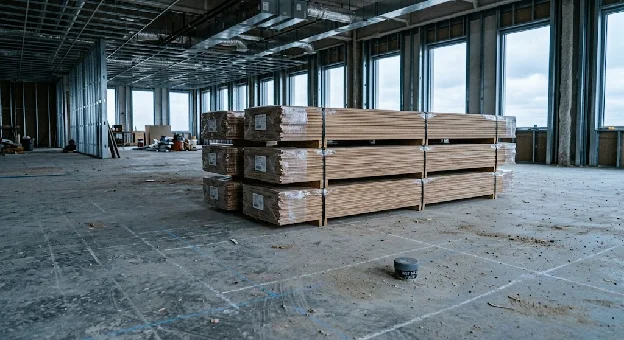
Proper substrate preparation, environmental controls, and routine maintenance are critical factors in safeguarding your commercial flooring investment from premature wear and costly repairs.
Concrete Moisture Testing and Mitigation
Because hardwood is a natural material, a few site conditions have an outsized effect on how well it performs once installed. Concrete moisture is one of the most important. Slab moisture should be evaluated before installation using ASTM F2170, the ASTM International standard for in-situ relative humidity testing in concrete slabs. Manufacturer limits are typically 75% RH, and a reading above that means the substrate needs moisture mitigation before any flooring goes down. Skipping this step can put adhesion, dimensional stability, and material warranty coverage at risk.
Acclimation and Building HVAC Conditions
Acclimation is the other major factor. Wood needs time to adjust to a building's normal, occupied HVAC conditions before installation. Solid hardwood generally requires 5 to 7 days to acclimate, while engineered hardwood typically needs 2 to 5 days. Planning this window into a construction or renovation schedule helps the floor perform the way it is meant to once the space opens for business.
Above The Rest Floors & More runs this testing on every project rather than sampling, and installs to commercial guidelines published by the National Wood Flooring Association (NWFA) for substrate flatness, acclimation, fastening, and finishing. Where slab readings exceed the manufacturer's threshold, the substrate is mitigated with VersaGuard or an epoxy moisture barrier before any wood goes down.
Minnesota makes both of these harder than most markets. Forced-air heating through a Twin Cities winter routinely pulls interior relative humidity to 15% to 25% without active humidification, while an un-dehumidified building can run above 60% in July. Wood flooring needs roughly 30% to 50% year-round, so a commercial building here can sit outside the acceptable range in both directions within the same twelve months. That swing is also why acclimating to occupied HVAC conditions matters so much locally, since a building that has not been balanced yet is not representative of what the floor will actually live in.
Refinishing vs. Replacing: Getting the Most from a Hardwood Floor
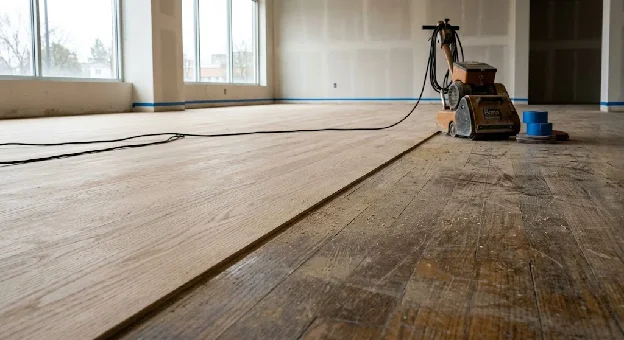
One of the most useful things to understand about commercial hardwood is that it does not have to be replaced the moment it starts to look worn. If an existing floor is structurally sound and still has at least 1/16 inch of wear layer remaining, refinishing can cost roughly 40% to 60% of full replacement, which makes it worth evaluating before assuming a full tear-out is necessary.
How many times a floor can be refinished depends on what it is made of:
| Product | Typical Refinishing Potential |
|---|---|
| Solid hardwood | Can typically be refinished 3 to 5 times |
| Engineered hardwood (4mm+ veneer) | Can typically be refinished once |
| Engineered hardwood (2mm veneer) | Generally cannot be refinished |
This distinction matters when comparing engineered products that may look identical on a sample board. A thicker wear layer gives a business more long-term flexibility, while a thinner veneer should be treated as a product with a shorter, non-renewable lifespan.
Where Hardwood Fits, and Where It Doesn't
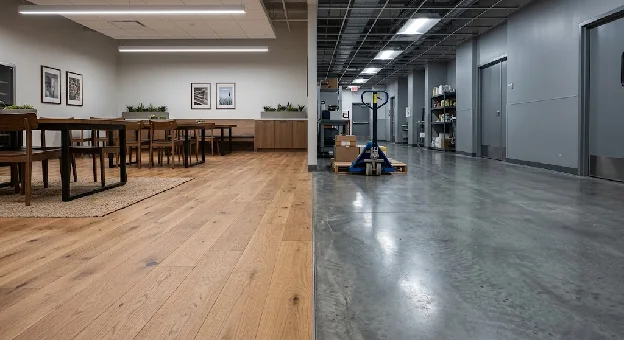
Hardwood performs well in spaces built around foot traffic and light rolling loads, such as office lobbies, boardrooms, reception areas, and dining rooms. It is not the right fit everywhere. Wet areas, warehouse or industrial traffic, and high-moisture concrete without mitigation are conditions where hardwood is not an appropriate finished floor. Forklift or pallet-jack traffic calls for polished concrete or an industrial epoxy coating instead. Matching the product to the environment, rather than choosing based on appearance alone, is what determines whether a hardwood investment holds up.
Frequently Asked Questions
Can engineered hardwood be refinished in a commercial space?
It depends on the veneer thickness. Engineered hardwood with a wear layer of 4mm or more can typically be refinished once, while a 2mm veneer generally cannot be refinished at all.
Why does a concrete slab need moisture testing before commercial hardwood installation?
Excess slab moisture can affect adhesion, cause dimensional instability in the wood, and void manufacturer warranty coverage. ASTM F2170 in-situ testing measures relative humidity in the slab so it can be addressed before installation if needed.
When is hardwood a poor choice for a commercial space?
Hardwood is not suited to wet areas, warehouse or industrial environments, or high-moisture concrete that has not been mitigated. Spaces with forklift or pallet-jack traffic are better served by polished concrete or an industrial epoxy coating.
Talk to Above The Rest Floors & More About Your Commercial Flooring Project
Above The Rest Floors & More has installed commercial flooring across the Twin Cities metro since 1998 and is 100% woman-owned, a qualification that matters for buyers with supplier-diversity requirements. A free project consultation is available to review your space, your substrate, and which hardwood construction fits your building conditions, and installations carry a 2-year written workmanship warranty. Call (651) 463-1250 to schedule a consultation for your Minneapolis, St. Paul, Fridley, Roseville or Anoka property.

About the author
Nick Winscher
Sales Manager / Senior Project Manager
Nick brings more than 20 years of commercial construction and flooring experience to project planning, underlayments, floor leveling, and delivery.