
Commercial hardwood floors can remain serviceable for decades, but their lifespan isn't determined by wood species alone. Finish condition, wear layer thickness, moisture exposure, traffic type, and indoor humidity all play a role in when a floor needs recoating, refinishing, or replacement. Understanding how these factors interact is the foundation of any useful hardwood flooring maintenance plan for a business, particularly in Minnesota, where seasonal humidity does as much damage to a floor as foot traffic.
What Actually Determines Commercial Hardwood Lifespan
A commercial hardwood floor should be evaluated based on how it will actually be used. Traffic type, rolling loads, cleaning exposure, the substrate underneath, and humidity conditions all determine whether routine maintenance can preserve the floor or whether the space is simply a poor fit for hardwood.
Hardwood Lifespan Factors:
- Foot traffic volume and type (public traffic, office traffic, retail traffic)
- Rolling loads such as carts or wheeled equipment
- Cleaning frequency and the products or methods used
- Substrate type (concrete or plywood) and its moisture condition
- Indoor humidity and stability across seasons
Hardwood is generally a poor choice for wet areas, high-moisture slabs without mitigation, warehouses, and spaces exposed to forklift or pallet-jack traffic. In those environments, even diligent maintenance can't overcome incompatible conditions. Polished concrete or an industrial epoxy coating is the appropriate specification. Hardwood tends to perform best in office lobbies, boardrooms, reception areas, hotel lobbies, restaurant dining rooms, and boutique retail settings, the environments commercial wood flooring is specified for across the Twin Cities metro.
Finish Maintenance vs. Wood-Life Preservation
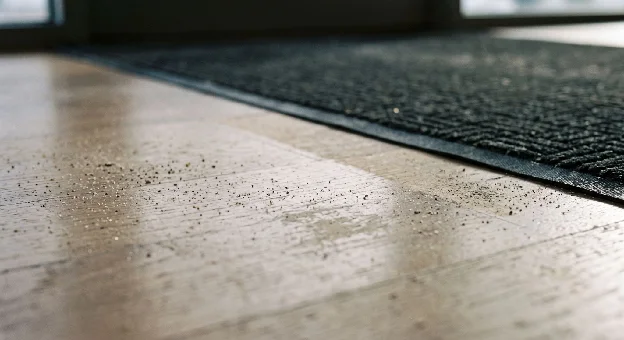
One of the most overlooked areas when caring for commercial hardwood is the difference between protecting the finish and preserving the wood itself. Dry soil, standing water, and abrasive debris tracked in at entryways damage the protective finish first. If recoating is delayed for too long, wear can progress past the finish and into the wood surface itself, turning a simple maintenance task into a full refinishing project.
Ice melt and grit at Minnesota entryways
Chloride-based ice melt tracked in from Twin Cities sidewalks leaves a white haze on wood finishes and is corrosive to the finish layer. Grit is the bigger problem because it acts as sandpaper underfoot. In a lobby taking hundreds of entries a day, it grinds away the wear layer that determines whether the floor can ever be refinished. Roughly fifteen feet of walk-off matting captures the majority of tracked debris; most commercial entries have a fraction of that. Through a Minnesota winter, dust-mopping frequency at entries should increase accordingly.
This is why prompt maintenance matters more than maintenance intensity. A floor that receives a timely recoat stays in the "maintenance" category. A floor that's neglected past that point moves into "refinishing," and in some cases, "replacement."
Solid vs. Engineered Hardwood: Construction Sets the Rules
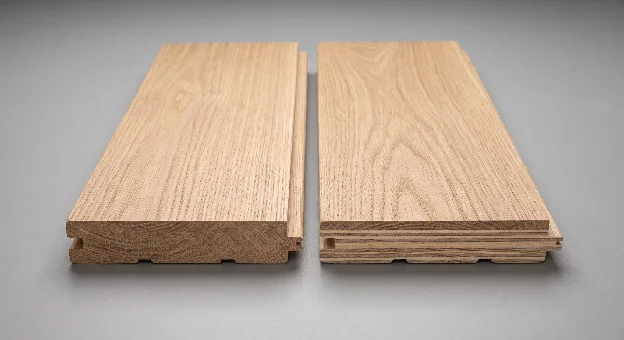
Solid hardwood requires a plywood subfloor and stable moisture conditions. Engineered hardwood uses a real-wood wear layer over a more dimensionally stable core, which allows it to be installed over concrete. This difference affects installation constraints and how many times a floor can be refinished over its life.
| Construction Type | Substrate Compatibility | Refinishing Capacity |
|---|---|---|
| Solid hardwood | Plywood subfloor required | Typically 3 to 5 times |
| Engineered hardwood (4mm+ veneer) | Concrete or plywood | Typically once |
| Engineered hardwood (2mm veneer) | Concrete or plywood | Generally cannot be refinished |
The thickness of the veneer should be part of the flooring decision for a commercial space. When an existing hardwood floor is structurally sound and still retains at least 1/16 inch of wear layer, refinishing may cost roughly 40% to 60% of full replacement, making periodic recoating and refinishing a meaningful lifecycle cost consideration.
Moisture, Acclimation, and Local Conditions That Affect Longevity
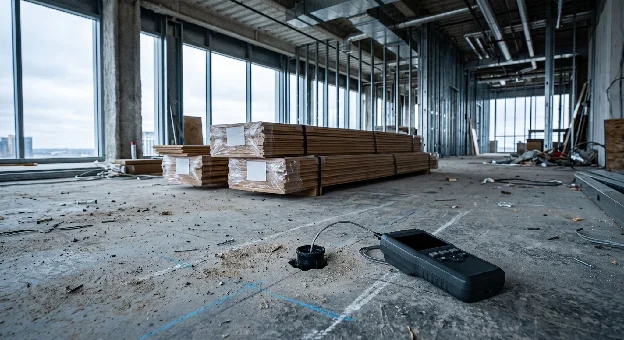
Protecting a commercial hardwood floor starts before maintenance ever begins. Moisture must be evaluated in concrete before wood installation, using ASTM F2170, the ASTM International standard for in-situ relative humidity testing in concrete slabs, to assess internal moisture against manufacturer-specific limits. Excessive moisture can contribute to adhesive failure, cupping, dimensional movement, and warranty risk down the line.
Wood should also be allowed to acclimate with the building HVAC operating under normal conditions, generally 5 to 7 days for solid hardwood and 2 to 5 days for engineered hardwood. Installing before the building environment is stable can put a floor under stress from day one.
Minnesota exposes wooden floors to a wider range of annual humidity than most of the country. Across the Twin Cities metro (Minneapolis and St. Paul and the suburbs from Anoka down through Bloomington), forced-air heating routinely pulls interior relative humidity to 15% to 25% through winter without active humidification, while an un-dehumidified building can run above 60% in July. Wood flooring needs roughly 30% to 50% year-round, which means a commercial building here can sit outside the acceptable range in both directions within the same twelve months.
The result is gapping in January as boards shrink and cupping in July as they take moisture back on. Wide planks and solid hardwood show both more visibly, which is one reason engineered dominates commercial specifications in this market. For a facility manager, the practical step is treating relative humidity as a maintenance metric. Put a hygrometer in the space and manage the band, not just the surface. For a deeper look at how substrate moisture is addressed before installation, see moisture mitigation for concrete subfloors.
How Above The Rest Floors & More Supports Long-Term Performance
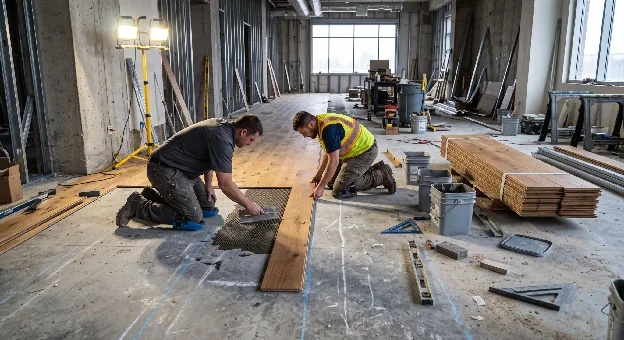
A commercial hardwood floor's lifespan is shaped by the substrate and preparation work as much as by surface maintenance. Above The Rest Floors & More installs to commercial guidelines published by the National Wood Flooring Association (NWFA) for substrate flatness, acclimation, fastening, and finishing, and runs ASTM F2170 in-situ probe testing on every project rather than sampling. Where readings exceed the manufacturer's threshold, typically 75% RH, the slab is mitigated with VersaGuard or an epoxy moisture barrier before any wood goes down.
When an old floor is removed, the adhesive left on the slab has to come off too. The Clean Slate process strips it chemically rather than grinding over it, because a new floor bonded to a failing adhesive layer will fail the same way the old one did.
This preparation work matters most in office and tenant spaces, where surface flatness and long-term appearance carry added weight. See flooring for office and tenant-improvement projects for more on that type of work.
Above The Rest Floors & More was founded in 1998 and is 100% woman-owned, a qualification that can matter for commercial buyers where supplier-diversity credentials are relevant.
Frequently Asked Questions
How can a business tell whether hardwood needs a new protective coat or a full refinishing?
If wear is limited to the finish layer and the wood underneath is undamaged, a recoat can restore protection. Once wear has reached the wood itself, a full refinishing (sanding and refinishing the surface) is typically needed.
Can engineered hardwood be refinished in a commercial space?
It depends on the wear layer thickness. Engineered hardwood with a veneer of 4mm or thicker can typically be refinished once, while a 2mm veneer generally cannot be refinished at all.
What conditions shorten the lifespan of commercial hardwood flooring most?
Excess moisture in the substrate, uncontrolled indoor humidity, heavy rolling loads, and delayed recoating are some of the biggest factors that shorten service life. Species affects surface hardness (hard maple and white oak hold up best under public traffic), but no species compensates for a wet slab or a floor that never gets recoated.
If you manage a commercial space and want a clear picture of your hardwood floor's remaining life and maintenance needs, Above The Rest Floors & More offers a free project consultation, and installations carry a 2-year written workmanship warranty. Call (651) 463-1250 to schedule a review for your Minneapolis, St. Paul, Fridley, Roseville, or Anoka property.

About the author
Nick Winscher
Sales Manager / Senior Project Manager
Nick brings more than 20 years of commercial construction and flooring experience to project planning, underlayments, floor leveling, and delivery.