
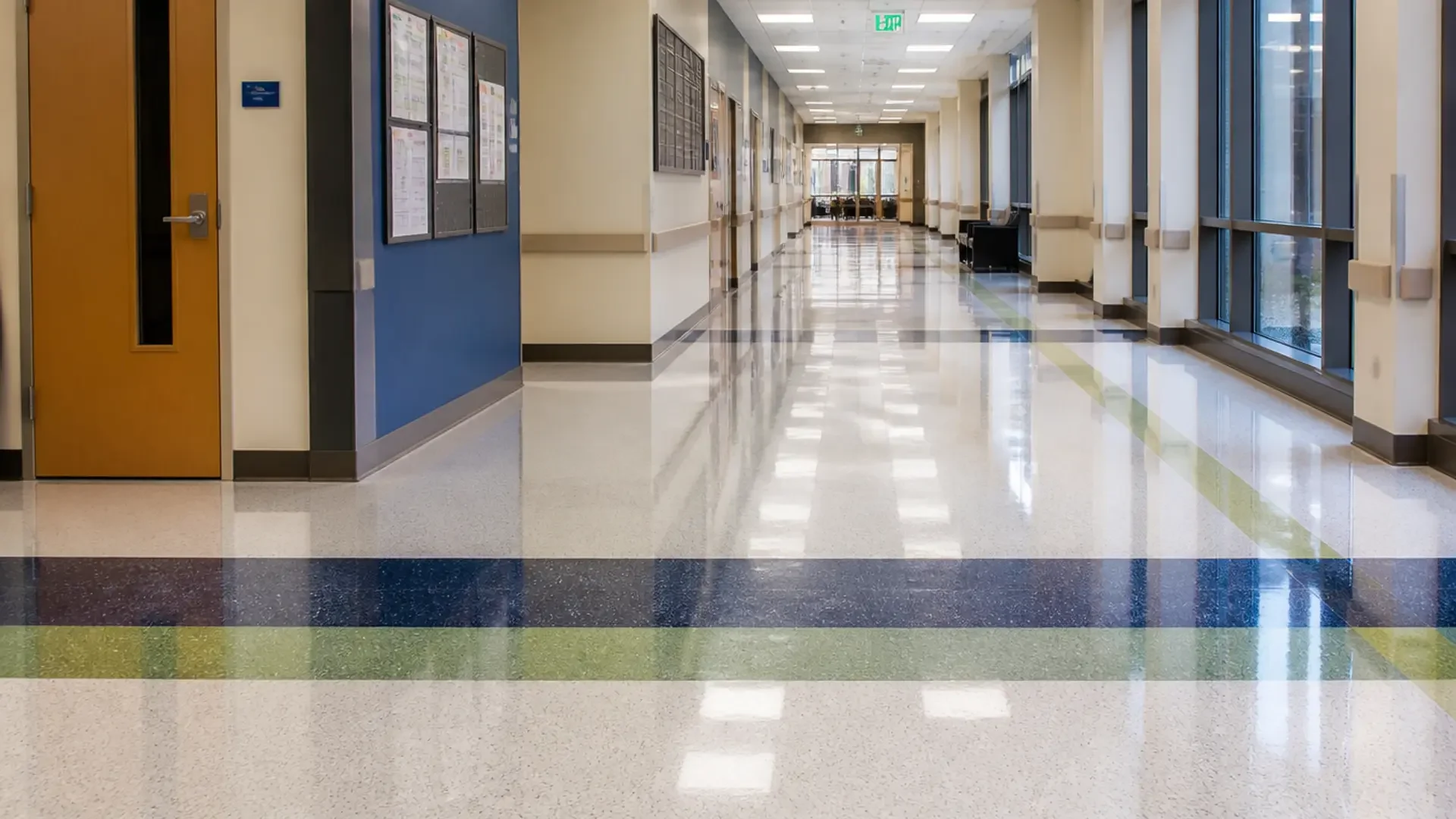
Maintaining VCT Floors in Twin Cities Schools and Healthcare Facilities
Published October 29, 2026
Vinyl composition tile (VCT) is a durable, cost-effective choice for schools, clinics, and other high-traffic commercial spaces across the Twin Cities. But its long-term appearance and performance depend almost entirely on how well the protective finish layer is maintained. Understanding when to clean, when to recoat, and when a floor needs full restoration (or even replacement) can save facilities significant time, money, and disruption.
This guide breaks down a practical VCT maintenance approach for schools and healthcare environments, where traffic patterns, occupancy schedules, and infection-control expectations all shape the right plan.
Why VCT Maintenance Is Really Finish Maintenance
The appearance and protection of a VCT floor depend on its finish layer, not the tile itself. The core maintenance goal is to remove abrasive dirt, preserve that finish, and renew it before wear becomes permanent. New VCT typically requires proper initial cleaning followed by three to five coats of commercial floor polish before it goes into service, according to Armstrong Flooring. Everything that happens afterward, daily soil removal, periodic burnishing, and eventual recoating, exists to protect that initial finish investment.
Abrasive dirt and grit can scratch the finish, while overly aggressive cleaning chemicals or stripping solutions can damage the tile's appearance and finish performance over time. Controlling entryway soil and using appropriate cleaning chemistry are two of the simplest ways to extend the time between restoration cycles.
Routine Care vs. Scrub-and-Recoat vs. Full Restoration
Not every dull or worn VCT floor needs a full strip and refinish. Knowing which level of intervention a floor actually needs can prevent wasted labor and unnecessary facility disruption.
- Routine care: Regular dust mopping, wet mopping, and soil removal to prevent abrasive grit from scratching the finish.
- Scrub-and-recoat: Appropriate when wear is limited to the upper finish layer. This restores protection and shine without stripping the floor down to bare tile.
- Full strip and refinish: Appropriate when finish buildup, embedded soil, or wear extends beyond what maintenance-level renewal can correct.
Treating every dull floor as an automatic full-restoration project wastes resources. The decision should be based on how deep the wear actually goes, not just how the floor looks at a glance.
School Facilities: Planning Around the Summer Window
Twin Cities K-12 flooring work is commonly constrained by a 10 to 12 week window between the end of the school year and mid-August, when furniture needs to be back in place. Above The Rest Floors & More delivers tear-out through furniture-ready flooring within that window when scope and conditions allow.
Because that access window is tight, heavy VCT restoration or replacement planning should begin well before summer, not after the school year ends. Facilities that wait until June to evaluate their floors often lose valuable scheduling time. If you're planning ahead for a school flooring project, our K-12 and Higher Education Flooring team can help structure that timeline.
Healthcare Facilities: Cleaning Requirements Vary by Area
Healthcare floor care is not one-size-fits-all. According to the Centers for Disease Control and Prevention, in general patient-care areas, floors should be cleaned daily under normal circumstances, while disinfectant is not routinely necessary unless the care area, visible contamination, or facility protocol indicates otherwise. In specialized spaces such as procedure areas, cleaning and disinfection frequency can be higher and tied directly to patient-care activity or terminal cleaning.
The CDC also prefers floor-cleaning methods that minimize mist, aerosols, and dust dispersion in patient-care areas, which affects how equipment and work schedules should be planned in occupied healthcare environments.
In short, applying the same VCT maintenance schedule uniformly across an entire healthcare building overlooks real differences between a general corridor and a procedure room.
When a Maintenance Problem Is Actually a Substrate Problem
Normal finish wear is expected and manageable through routine maintenance. But recurring resilient-floor issues, such as bubbling, releasing, or finish that won't hold, can point to something beneath the tile rather than a cleaning routine gap.
Above The Rest Floors & More performs ASTM F2170 relative-humidity testing on every resilient-flooring project and adds self-leveling compound or moisture mitigation when slab conditions require it. If a facility is seeing the same floor problems return again and again despite consistent maintenance, that pattern is worth evaluating as a potential moisture or substrate issue rather than another round of cleaning or recoating.
This is also where ongoing VCT problems can signal a bigger decision. Above The Rest Floors & More installs resilient flooring, including sheet vinyl, LVT, vinyl plank, and rubber, with substrate preparation and leveling handled under the same contract. In healthcare settings specifically, where continuous heat-welded seams are needed for hygiene or infection-control requirements, sheet vinyl can be a more appropriate material choice than VCT. Reviewing commercial resilient flooring options can help facilities weigh ongoing maintenance against a longer-term material change.
Working Around Occupied Buildings
Schools and healthcare facilities rarely have the luxury of shutting down for floor work. For occupied healthcare, education, hospitality, and multifamily areas, Above The Rest Floors & More coordinates removal, preparation, installation, transitions, and turnover in controlled phases, which helps limit disruption while work is underway. Facilities planning flooring changes in active buildings, including senior living and healthcare environments, can plan around this phased approach rather than waiting for a full building closure.
Frequently Asked Questions
When should a facility scrub and recoat VCT instead of stripping and refinishing it?
Scrub-and-recoat is appropriate when wear is limited to the upper finish layer. Full stripping and refinishing is better suited to floors with finish buildup, embedded soil, or wear that maintenance-level renewal can't correct.
Does routine healthcare floor cleaning always require disinfectant?
No. In general patient-care areas, CDC guidance calls for daily cleaning, but disinfectant isn't routinely necessary unless the area, visible contamination, or facility protocol calls for it. Specialized clinical areas may require more frequent cleaning and disinfection tied to patient-care activity.
When do recurring VCT or resilient-floor problems require a moisture or substrate evaluation?
If floor issues such as bubbling or releasing keep coming back despite consistent maintenance, that pattern can point to slab moisture or flatness conditions rather than a cleaning issue, and may warrant relative-humidity testing.
Plan Your Next Flooring Project with Above The Rest Floors & More
Whether your school or healthcare facility needs a maintenance plan, a scrub-and-recoat evaluation, or a conversation about replacing aging VCT with a resilient flooring system built for your space, Above The Rest Floors & More serves facilities throughout the Twin Cities metro area, including Minneapolis, Fridley, Roseville, and Anoka. Call (651) 463-1250 to talk through your facility's flooring needs and summer scheduling windows.

About the author
Nick Winscher
Sales Manager / Senior Project Manager
Nick brings more than 20 years of commercial construction and flooring experience to project planning, underlayments, floor leveling, and delivery.