

How to Protect Commercial Carpet from Winter Salt Damage in Minneapolis & St. Paul
Published November 4, 2026
Twin Cities winters send a steady mix of ice melt, slush, and grit through commercial entrances for months at a time, and that tracked-in residue is one of the fastest ways to wear down carpet before its time. Most salt-related carpet problems come down to what happens at the door and how residue is cleaned and dried, not a flaw in the carpet itself. This guide walks through entrance prevention, safe residue removal, proper drying, and how to tell a cleaning issue apart from carpet that actually needs repair or replacement.
Why Tracked-In Ice Melt Is Harder on Carpet Than It Looks
Ice melt tracked indoors does more than leave a white haze. As it dries and crystallizes, it can create abrasive particles that grind against carpet fibers with every footstep, along with a sticky residue that attracts and holds onto additional dirt. Colored deicing products can also leave staining behind. That combination is why winter carpet care in a commercial building needs more attention than a quick vacuum.
Stop Salt at the Door: Entrance Prevention

The most effective carpet protection happens before anyone reaches the carpet at all. Minnesota's property management guidance on winter salting recommends removing snow and ice before applying deicer, keeping application tools and instructions available right at entryways, and sweeping up excess salt once it has done its job (Minnesota Pollution Control Agency). That outdoor discipline, paired with the right matting indoors, cuts down significantly on what ever reaches carpeted areas.
- Remove snow and ice before deicer is reapplied, and sweep up excess product once walkways are safe.
- Use interior walk-off matting in addition to exterior scraper mats. Manufacturer guidance from Interface specifies at least six feet of interior matting to capture the finer soil and moisture that scraper mats miss (Interface Americas Carpet Tile Maintenance Guide).
- Vacuum mats and adjacent carpet daily, and more often at weather-exposed entrances or high-traffic barrier mats, so the matting does not become its own source of soil.
Removing Ice Melt Residue Without Damaging the Carpet
Not every ice melt product behaves the same way once it is on carpet. Cleaning chemistry can vary depending on whether the deicer is calcium-based or magnesium-based, so a single go-to cleaner is not a safe assumption for every building or every product in use. The safer approach is to confirm what is appropriate for the carpet and the deicer involved before treating a spot. The Carpet and Rug Institute recommends pretesting any cleaner, following its label directions, and blotting liquid spots rather than scrubbing them aggressively, which helps avoid texture changes, fraying, or spreading the residue further.
Drying Matters as Much as Cleaning
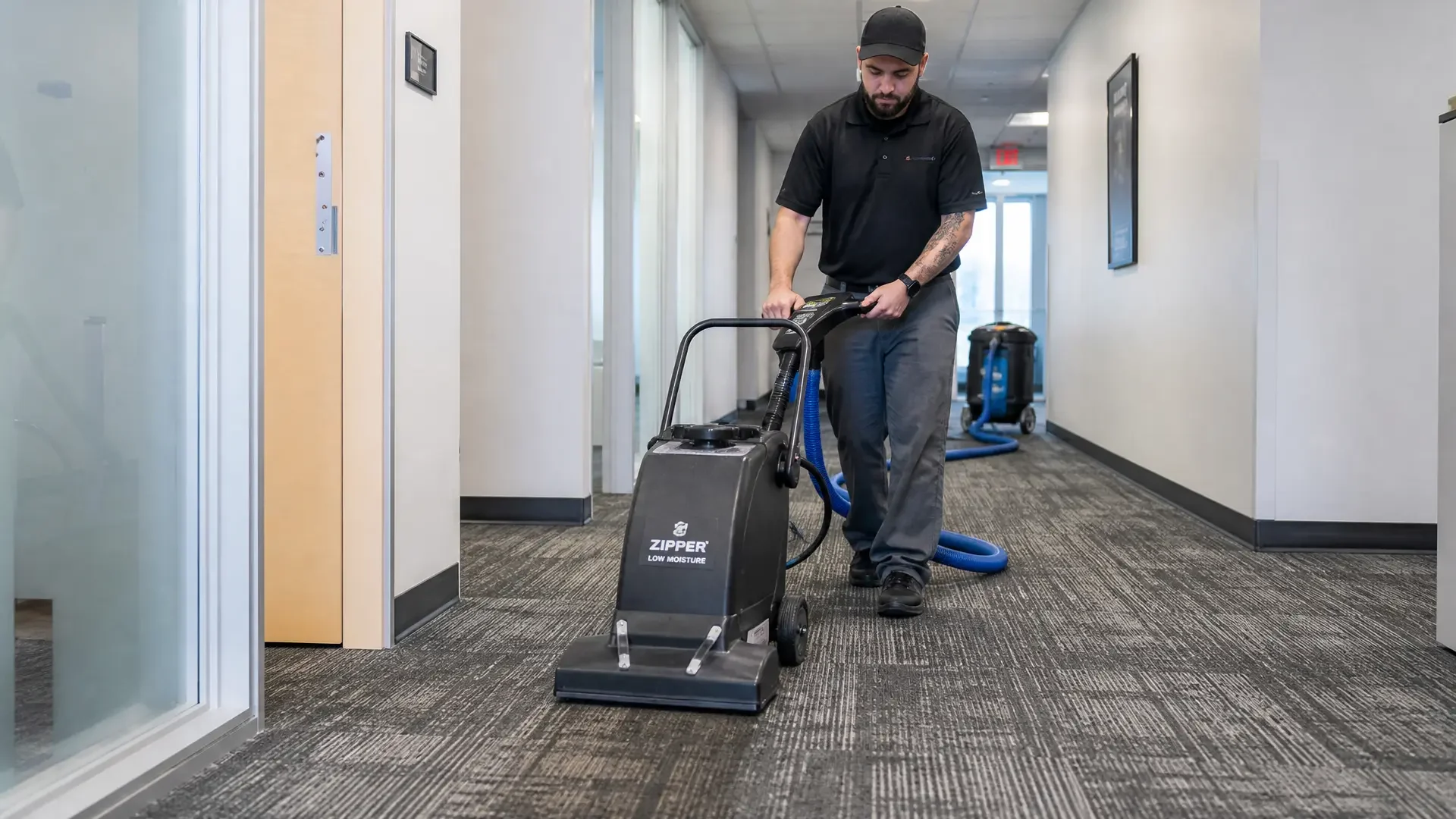
Once residue has been treated, how the carpet dries is just as important as how it was cleaned. Overwetting should be avoided, and the area needs real moisture removal, ventilation or air movement, and foot traffic kept off until it is fully dry. It is also worth knowing that residual ice melt can wick back up to the surface while carpet dries, showing up as a white mark that was not fully gone the first time. A returning deposit is usually a sign to reassess the cleaning, not automatic proof that the carpet is damaged beyond recovery.
When a Salt Mark Is a Cleaning Problem, and When It's Carpet Damage
Most winter carpet issues in Twin Cities commercial spaces respond to the entrance prevention and cleaning steps above. But carpet exposed to repeated salt exposure over multiple seasons can reach a point where fibers are genuinely worn, matted, or discolored beyond what cleaning can address. That is a different conversation than a surface residue problem, and it is worth a second look before assuming either outcome.

Above The Rest Floors & More offers Carpet Repair, Carpet Installation, and Commercial Carpet Repair & Installation for properties across the Twin Cities / Minneapolis-St. Paul metro. If a commercial carpet installation is the right call, you can review commercial carpet installation options for the space. For occupied buildings, flooring work can also be planned around flooring work in occupied offices so operations are not disrupted any more than necessary.
Protect Your Commercial Carpet This Winter
If salt stains, matting, or wear keep coming back no matter how often your carpet gets cleaned, it may be time for a professional look rather than another round of spot treatment. Above The Rest Floors & More offers free project consultations for commercial properties throughout the Twin Cities metro, including Minneapolis, Fridley, Roseville, and Anoka. Call (651) 463-1250 to schedule a consultation and find out what your carpet actually needs this winter.

About the author
Nick Winscher
Sales Manager / Senior Project Manager
Nick brings more than 20 years of commercial construction and flooring experience to project planning, underlayments, floor leveling, and delivery.